Labour budget left
Compare the estimated labour allowance with the cost created by regular and overtime hours.

Budget versus actual
Compare the original estimate with recorded labour, material and subcontractor costs while construction is still in progress.
A single project total can hide the source of an overrun. ActualCost keeps estimated labour, materials and subcontractors visible separately and calculates the remaining budget for each category.
Budget left = Estimated cost − Actual cost
Compare the estimated labour allowance with the cost created by regular and overtime hours.
Compare the estimated material allowance with supplier costs assigned to the job.
Compare the outside-work allowance with subcontractor entries without mixing them into team days.
Combine all three actual-cost categories to understand the complete current position.
Budget-versus-actual tracking is most valuable while there is still time to investigate a loss, correct purchasing, adjust labour planning or price similar work more accurately next time.
Read the practical guide: Estimated cost versus actual cost in construction.
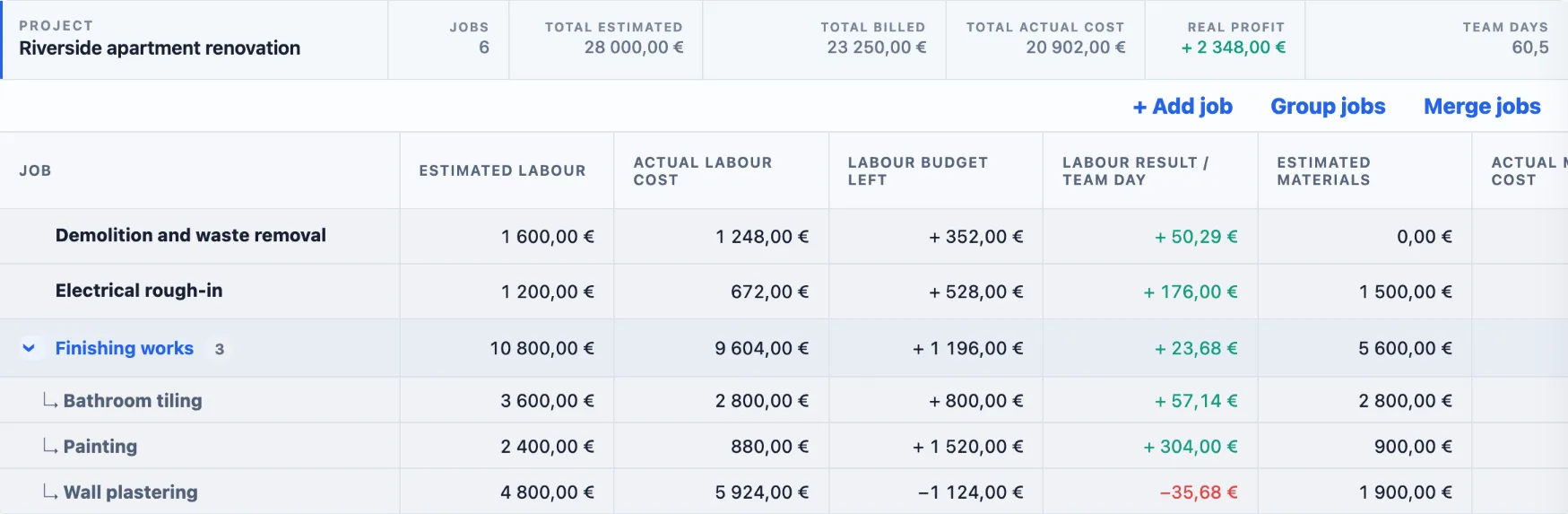
Two jobs from the same demo renovation, five weeks in:
| Job and category | Estimated | Actual | Budget left |
|---|---|---|---|
| Wall plastering — labour | 4 800,00 € | 5 924,00 € | −1 124,00 € |
| Wall plastering — materials | 1 900,00 € | 1 942,00 € | −42,00 € |
| Bathroom tiling — labour | 3 600,00 € | 2 800,00 € | +800,00 € |
| Bathroom tiling — materials | 2 800,00 € | 1 872,00 € | +928,00 € |
The project total is still in profit, so a project-level view would show nothing wrong. Per job and per category, the picture is clear: plastering labour is the problem, not materials and not tiling.
Budget left is the estimate minus the actual cost so far, shown separately for labour, materials and subcontractors. A positive number is still available; a negative number means the job has already cost more than estimated.
No. Budget left compares the estimate with actual cost. Billing is compared separately: real profit is total billed minus total actual cost.
A team day is 8 logged hours. The labour result per team day divides the labour budget left by the team days spent, which makes jobs of different sizes easy to compare.
If a job has no separate subcontractor estimate, subcontractor costs on that job use up its labour budget, because they replaced your own team. If the job has its own subcontractor estimate, the two are compared separately.
Weekly during active work is a good rhythm. The earlier an overrun is spotted, the more can still be done: correct an allocation, change the plan or agree extra work with the client.